space
Sep 4, 2026
Satellite Megaconstellations
What happens when the systems built to connect Earth interfere with our ability to study the universe beyond it? By Karla Badoussi
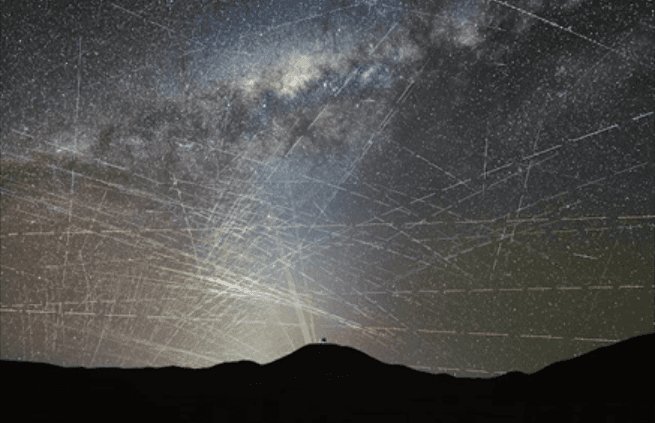
The rapid growth of satellite constellations over earth is reshaping the night sky and complicating how we explore and study space, turning what was once a distant concern into an urgent challenge for astronomers. In the last decade, more than fifteen thousand satellites were launched into Low Earth Orbit, with many more planned estimates indicating that there will be at least forty thousand by 2030. Commercial constellations such as SpaceX's Starlink are swarming around our world, disrupting astronomical work, increasing risks of collisions in orbit, and raising atmospheric and environmental concerns. This, while also bringing high-speed internet to remote regions of the world and making internet connection more accessible.
The problem stems from the scale of these networks interfering with astronomical observations both in earthbound observatories like the Vera C. Rubin Observatory, and space telescopes such as Hubble. The satellites reflect sunlight in bright streaks that contaminate telescope images by leaving bright streaks across the captured images; the contaminated data is then rendered useless. Because these megaconstellations operate at higher altitudes than most space telescopes in Low Earth Orbit (Hubble is 530-540 km above Earth, Fermi Gamma-ray at 540-565 km, and XRISM at 522-575 km) the satellites cross right through their field of view, telescopes on earth are affected in the same way. Satellites can be seen with the naked eye during the hours before sunrise and after sunset; at those times they reach peak brightness as they reflect sunlight from below the horizon.
In response, space telescopes have been shutting down their imaging during those times to limit the amount of corrupted data. Not all satellites have this liberty; it isn’t just about light. They also broadcast radio signals down to Earth for broadband internet. These transmissions leak into reserved frequency bands meant for radio telescopes like the Square Kilometre Array. These leaks drown out the faint radio signals emanating from distant galaxies, pulsars, and black holes. Further hindering astronomical work. Because radio telescopes do not have fixed operation times and look towards the sky constantly, there isn’t a direct way to limit the impact satellites have on them.
Specialized optical telescopes are used by astronomers at twilight to search for near-Earth asteroids because it is then that conditions are ideal for observing regions near the sun. Because satellites are brightest at twilight, spotting potentially hazardous asteroids becomes much more difficult.
The impact of satellite constellations doesn’t stop here; they also interfere with rocket launches making complex trajectory calculations an important pre-launch precaution to avoid high-speed traffic in the congested areas over the planet. Scientists worry that growing orbital congestion could trigger the Kessler Syndrome: a chain reaction where two satellites collide at orbital speeds, shattering into thousands of lethal fragments that strike other spacecraft, generating even more debris until entire orbital bands become too dangerous to use.
Starlink is one of the prime examples when it comes to mega-constellations; it is the most numerous and one of the newer ones. Every day, a few Starlink satellites fall back to earth, often because of their lifespans coming to an end, or malfunctions occurring. Other times crashes are due to high solar activity in which atmospheric drag in Low-Earth orbit increases. This makes the atmosphere traveled in by satellites unusually thicker, causing them to slow down, lose altitude, and eventually incinerate in earth's atmosphere. Re-entering spacecraft release large amounts of metallic particles—especially copper and other rare elements—into the stratosphere, the same region where commercial jets fly, and the ozone layer resides. These tiny particles can act as surfaces for chemical reactions that slowly degrade ozone.
As the number of objects in LEO continues to grow, the consequences are becoming impossible to ignore. The question now is how we respond: what regulations, technologies, and long‑term strategies can actually make space operations sustainable.
Proposed solutions include: re-designing satellites, international policy and regulation, as well as debris reduction.
Visual astronomers are avoiding areas where satellites will pass. Satellite operators are coming out more transparent about their work and communicating with policy makers and astronomers, sharing data that could improve the mitigation of megaconstellations. New satellite designs are using anti-reflective coatings, solar visors, even changing their orientation in orbit to minimize flares. Major astronomical organizations like the IAU and the European Southern Observatory are now pushing for international rules that limit satellite brightness and cap the number of active spacecrafts in LEO. Alongside pre‑launch environmental assessments and minimum light‑pollution standards, these measures form the groundwork for a future where global connectivity doesn’t come at the expense of the night sky, and where space remains a place we can study, explore, and rely on.
Image sourced via ESO Wikicommons/Friends of NASA. Used for editorial purposes only. No commercial use. All rights belong to their respective owners.

